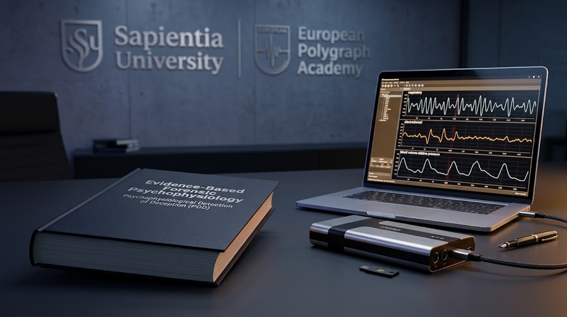
Step inside the ultimate theoretical and computational engine room of credibility assessment. Discover my definitive international treatise on cognitive load architecture, neural networks, and the future of neuro-rights.
Throughout my decades of academic, institutional, and operational leadership at the helm of forensic psychophysiology, I have consistently campaigned for a total paradigm shift. Credibility assessment cannot remain an artisanal craft dependent on an examiner’s subjective «clinical eye» or pop-psychology body language myths. While my companion manual, Polygraph Testing, serves as a surgical guide for field protocols and step-by-step execution, our discipline desperately required an authoritative, high-level scientific treatise to establish its neurobiological and computational foundations.
To address this global scientific void, I am proud to present the definitive 2026 edition of Evidence-Based Forensic Psychophysiology: “Psychophysiological Detection of Deception (PDD): A Practical Manual”.
Published by Sapientia University of Andorra, this reference manual explicitly breaks away from traditional literature to frame credibility assessment as a robust, auditable data science. It moves the discipline entirely into the territory of 24-bit medical-grade signal acquisition, machine learning, and advanced algorithmic interpretation, while fiercely defending individual sovereignty in the coming era of neural screening.
To secure your technical copy immediately in a secure digital format (PDF), you can access the official academic download portal of Sapientia University:
🛒 DIRECT ACCESS TO THE SECURE DIGITAL GATEWAY:
👉 Download «Evidence-Based Forensic Psychophysiology» at Sapientia University
Instant digital delivery of the encrypted technical file (17.45 MB) begins immediately after secure payment processing via Stripe or PayPal.
The Copernican Shift: Cognitive Load and the Metabolic Bill
For nearly a century, polygraphy operated almost exclusively under the «fear of punishment» or «fight-or-flight» model. While the acute emotional response to a threat is real, modern neuroscience has revealed a much deeper, more generalizable, and far less maskable mechanism: cognitive load.
As I state in the introduction of my treatise:
«A lie is not a biological signal; it is a complex cognitive and social process. There is no universal ‘lying response.’ What does exist is the involuntary physiological echo of the mental and emotional effort required to deceive when the stakes are meaningful.»
The human brain is a processor with strictly finite metabolic resources. Telling the truth is our biological default state; it is a low-energy task that simply accesses intact records in episodic memory and verbalizes them automatically. Deception, by contrast, completely hijacks the executive networks of the prefrontal cortex (PFC). When a subject chooses to lie, their brain must fuel multiple high-demand operations concurrently:
- The ventrolateral prefrontal cortex (vlPFC) acts as an emergency brake, exerting powerful response inhibition to suppress the automatic truth.
- The dorsolateral prefrontal cortex (dlPFC) manages working memory, working tirelessly to construct a coherent alternative narrative, maintain it over time, and avoid internal contradictions.
- The orbitofrontal cortex (OFC) acts as a risk assessor, continuously calculating the cost-benefit ratio of exposure and monitoring the examiner’s facial expressions.
This parallel neural activity generates an inescapable «metabolic bill.» The brain demands an immediate reallocation of oxygenated blood and glucose to sustain its executive effort. The anterior cingulate cortex (ACC) acts as the conflict monitor, detecting the profound dissonance between memory and speech, and triggers a descending sympathetic alarm through the hypothalamus.
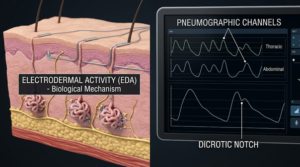
To fulfill this brain-directed energy surge, the body adjusts homeostatically: it suppresses respiration to minimize mechanical noise, expands central arteries to deliver blood flow to the cortex, and floods eccrine sweat glands via cholinergic pathways. My manual teaches you how to measure this metabolic price tag with absolute mathematical precision.
Comprehensive Syllabus Architecture: The 15 Chapters
I have built this manual into a comprehensive, five-block progressive structure designed to turn biological traces into auditable, courtroom-grade evidence:
Block 1: Scientific Foundations & Historical Development (Chapters 1–2)
Dives deep into the conceptual archaeology of credibility verification. It traces the shift from primitive pharmacology (the Calabar bean poison ordeals) to cognitive science. It thoroughly maps the neurobiology of deception, introducing Polyvagal Theory to explain the ventral vagal «smart brake» and the dorsal vagal shutdown that causes misleadingly flat charts in traumatized subjects.
Block 2: Exam Engineering and Stimulus Construction (Chapters 3–5)
The physical and psychological toolbox. It details signal transduction engineering—explaining why constant voltage (CV) circuits are strictly superior to legacy constant current (CC) designs for EDA. It then teaches how to construct precise, non-confrontational psychological stimuli (Neutral, Relevant, and Comparison questions), stripping out emotionally loaded «trigger words» to avoid false positives.
Block 3: Methodology, Scoring, and Forensic Synthesis (Chapters 6–7)
The technical heart of the protocol. It maps internationally validated formats—including the Zone Comparison Technique (ZCT), Multi-Issue MGQT, and the cognitive Concealed Information Test (CIT). It covers the chronobiology of the in-test phase, enforcing a strict 20–25 second Inter-Stimulus Interval (ISI) to allow homeostatic recovery. It teaches the mathematics of manual scoring systems (ESS-M) and numerical spot evaluation.
Block 4: Countermeasure Interception & Algorithmic Vetting (Chapters 8–9)
Hardening the examination against active sabotage. It provides an operational manual to detect physical, mental, and chemical countermeasures. It resolves the «Effort Paradox»: the theorem proving that the conscious execution of a countermeasure generates an artificial, high-frequency «dirty» morphology (staircasing, plateaus) that exposes the saboteur and results in a binding finding of Purposeful Non-Cooperation (PNC).
Block 5: AI Revolution, Expert Testimony, and Neuro-Rights (Chapters 10–15)
The technological and ethical vanguard. It traces the digital revolution from first-generation expert systems (OSS-3, PolyScore) to second-generation Deep Learning architectures. It dissects the use of Recurrent Neural Networks (RNN) and Long Short-Term Memory (LSTM) gates to model time-series data. It prepares the expert for the witness stand under the Daubert standard, introduces emerging stand-off biometrics (periorbital thermography and laser Doppler vibrometry), and concludes with an essential manifesto on Neuro-Rights and cognitive liberty.
Taming the Black Box: The Imperative of Explainable AI (XAI)
One of the most consequential segments of Evidence-Based Forensic Psychophysiology addresses the modern forensic crisis introduced by deep learning algorithms. As an expert witness who has testified in high-stakes environments, I address this dilemma directly within the text:
«An advanced machine learning model can evaluate a physiological time series with a predictive accuracy that easily surpasses human sight, but it operates as an opaque black box. If an LSTM network flags a subject as deceptive with a 99.2% probability, but cannot explain how it combined its internal weights to get there, the evidence is legally inadmissible under strict judicial standards. Courts demand an explainable process, not a digital oracle.»
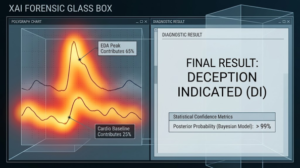
To bridge the gap between AI power and judicial accountability, my manual champions the integration of Explainable Artificial Intelligence (XAI). Through Layer-wise Relevance Propagation (LRP) and sensitivity analysis, modern software can open the black box into a clear «Glass Box».
Instead of an unverified number, the XAI interface overlays a precise Saliency Heatmap onto the subject’s chart waveforms. It colors the exact milliseconds of respiratory suppression or the precise slope of the skin conductance upstroke that drove the algorithm’s decision, breaking down the specific contributions (e.g., EDA peak: 65%, Cardio baseline: 25%) into clear text. This enables a true hybrid model where the human perito can audit the AI’s logic, isolate physical artifacts, and present a mathematically and legally unassailable report.
Technical Specifications & Institutional Distribution (2026 Edition)
To guarantee full methodological traceability and eliminate uncertified malpractice, the official distribution of this treatise is securely managed through our academic channels:
- 1. Premium Digital Vault Edition (Secure PDF Manual): Available for instant download on the official Sapientia University technical gateway. This file contains the complete high-resolution vector color plates, tables, and saliency heatmaps.
- Official Download Portal: https://sapientiauniversity.com/ebook/polygraph-testing/
- Transaction Security: The order form uses advanced SSL encryption linked directly to certified Stripe and PayPal gateways; instant file delivery follows payment confirmation.
- Official Price: $71.88
- File Size: 17.45 MB
- 2. Kindle Global Digital Edition (Amazon KDP): Designed for synchronization and permanent archival across all electronic readers within the Amazon Kindle global platform.
- Official Amazon KDP Link: https://www.amazon.es/PRUEBA-DEL-POLÍGRAFO-Psicofisiología-Metodología-ebook/dp/B0GX2WN4F9
- 3. Upcoming Printed Reference Edition (Hardy Paperback): For laboratories, university libraries, and active trial peritos who require a physical volume open on their desks for visual scoring audits, I am pleased to announce that starting August 2026, the manual will be available in physical print as a heavy-duty, softcover paperback book. Print reservation forms will go live on the university gateway at the start of the summer semester.
Do not allow your investigative tools or your organization’s risk vetting to remain dependent on unverified intuition or outdated literature. Secure the definitive manual on 21st-century forensic biometrics and master the exact mathematics of empirical truth.
José A. Landa
Copyright © 2026, José A. Landa. All rights reserved. European Polygraph Academy / Sapientia University
Comentarios recientes