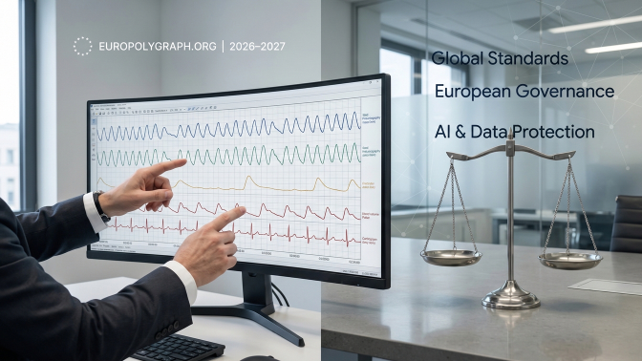
Those of us who dedicate our professional and academic lives to Forensic Psychophysiology know well that this discipline has never been static. Yet as 2026 draws to a close, it is worth pausing to examine with perspective the profound transformation we have just undergone. Mastering instrumentation or accumulating examination-room hours is no longer enough; today, the legitimacy of a psychophysiological credibility assessment rests on an inseparable tripod: replicable empirical rigor, technological transparency, and strict legal compliance.
In this landscape of international convergence, Europolygraph.org, consolidated as the world’s second-largest association in Forensic Psychophysiology, assumes a singular responsibility. Our mission is not to replicate uncritically models designed for other legal realities, but to build a sturdy bridge between global scientific standards and Europe’s demanding framework of fundamental rights, data protection, and artificial intelligence governance. This analysis, updated to November 2026, offers examiners, jurists, security directors, and academics a clear roadmap for operating with excellence in the cycle now beginning.
The New Regulatory Map: Technical Convergence and Validity Criteria
Over the past two years, the regulatory ecosystem of Psychophysiological Detection of Deception (PDD) has undergone a healthy process of refinement. For any laboratory or department seeking to maintain auditable Standard Operating Procedures (SOPs), it is essential to understand how three major references interact today: the APA, ASTM International, and Europolygraph.org’s own guidelines.
Consolidated Operational Standards
The American Polygraph Association (APA) Standards of Practice, effective since August 23, 2024, established benchmarks that now represent the minimum baseline for defensible international practice. Among its most relevant requirements for quality assurance and quality control (QA/QC) are:
- Validated accuracy thresholds: Techniques employed must be backed by replicated studies demonstrating at least 90% accuracy for evidentiary examinations (court use), 86% for paired testing, and 80% for investigative examinations, while keeping inconclusive rates below 20%.
- Mandatory in-person practice: All interaction—pretest interview, data collection, and posttest—must be conducted in person. The discipline rules out remote evaluations whenever they compromise environmental control and physiological validity.
- Duration and workload: A rigorous examination requires scheduling a minimum of 90 minutes and a cap of 5 examinations per day per examiner to neutralize cognitive fatigue.
- Instrumentation and recording: Continuous recording of two respiratory channels (thoracic and abdominal), electrodermal activity (EDA), cardiovascular activity, and a seat movement sensor is mandatory, accompanied by full audio or audiovisual recording following explicit informed consent.
- Continuing education and record retention: A minimum of 30 hours of continuing education every two years is required, alongside conservative retention policies (at least 3 years for case files and 1 year for audiovisual recordings, unless stricter legal mandates apply).
The ASTM E52 Realignment and Calibration Precision
In parallel, ASTM International’s Committee E52 streamlined its technical catalog during 2025. Training centers and internal manuals must update their citations: E2031 (Quality Control) and E2439 (Instrumentation) were withdrawn in 2025 and must no longer be presented as active standards. Nevertheless, the technical core of the series continues to provide valuable guidance through E2063 (calibration and functionality checks), E2229 (interpretation of PDD data), E2386 (screening examinations), and E2324 (paired testing).
Added to this is a quieter yet decisive evolution in the laboratory: the tightening of calibration criteria and baseline stability tolerances for pneumography and EDA sensors, aligned with the Empirical Scoring System–Multinomial (ESSM). Teaching and auditing why each calibration tolerance exists is now just as important as knowing how to apply the scoring formula.
The Doctrinal Contribution of Europolygraph.org
Beyond mechanical compliance with technical parameters, the quality of an examination begins before the first sensor is attached. In this domain, the guidelines published by Europolygraph.org address critical gaps in daily practice. On one hand, our Exclusion and Suitability Criteria (May 2024) clearly delineate when severe respiratory or cardiovascular pathology, neurological impairment, or recent substance use compromises physiological reliability and requires postponing or declining the test. On the other hand, our Practical Guide to Relevant and Comparison Question Formulation (October 2024) brings methodological rigor to test construction in validated techniques such as CQT and Utah CQT, where a single poorly resolved semantic nuance can invalidate an entire session.
Instrumentation and Artificial Intelligence: Precision Tools, Never Substitutes for the Examiner
On the technological front, the transition toward modern recording architectures has redefined in-room quality standards. By late 2026, advanced practices prioritize platforms that ensure signal stability, high sampling resolution, and seamless hardware-software integration. A clear benchmark of this evolution is the Stoelting CPS Elite paired with Fusion software, which combines 32-bit processing (~360 samples per second per channel) and flexible EDA, respiration, and motion sensing with a color touchscreen LCD built directly into the instrument. This architecture allows examiners to verify sensor integrity in real time without diverting attention from the examinee, elevating live quality control and streamlining workflow.
What AI Truly Contributes to Credibility Assessment
In the scientific arena, research published across 2024–2025 has opened promising avenues in automated signal analysis. Deep neural networks (CNN/LSTM architectures) designed to score physiological charts directly have achieved high performance metrics in controlled datasets (with F1 scores near 0.97), capturing non-linear relationships that traditional linear classifiers overlook.
The pretest interview phase is also seeing noteworthy innovations, such as AI-assisted behavioral baselining: non-invasively measuring shifts in response latency, speech rate, or micro-pauses relative to the interviewee’s own baseline.
As scientists, however, we must remain candid and prudent: a controlled laboratory is not the real world. Deep neural networks have yet to prove their robustness in field conditions against human countermeasures, and any linguistic deviation serves strictly as a heuristic to formulate sharper follow-up questions—never to conclude deception. Artificial intelligence is a remarkable analytical magnifying glass, but interpretive responsibility remains entirely with the qualified professional.
Legal Safeguards and Privacy: Operating Under the EU AI Act, GDPR, and ISO/IEC Standards
If one feature defines European practice in 2026, it is that ethics is no longer a statement of good intentions—it is binding positive law.
The European Union Artificial Intelligence Act (Regulation (EU) 2024/1689) has now passed two decisive milestones: since February 2, 2025, its absolute prohibitions have been in force—explicitly banning AI systems that infer emotions in workplace and educational settings, subject only to narrow medical or safety exceptions—and since August 2, 2026, the Act’s general applicability has governed transparency obligations and high-risk systems. For our profession, the message is unmistakable: any algorithmic support tool must be thoroughly documented, subjected to a Data Protection Impact Assessment (DPIA), and kept strictly separate from automated decision-making about individuals.
In parallel, safeguarding psychophysiological data—biological information of the highest sensitivity—demands a first-class privacy architecture. Coordinated enforcement actions by the European Data Protection Board (EDPB) on the right of access (Article 15 GDPR) remind practices that they must respond with accuracy and transparency whenever an examinee requests information on their records, profiles, or data recipients. To translate this legal mandate into daily operations, today’s gold standard combines:
- ISO/IEC 27701:2025: Privacy Information Management System (PIMS), essential for auditing retention policies and secure deletion of personal data.
- ISO/IEC 27018:2025: Specific safeguards for protecting personally identifiable information (PII) when cloud services are utilized.
- ISO/IEC 27001:2022/Amd 1:2024: Information security management and operational continuity against expanded risk factors.
This emphasis on documentary rigor is not unique to Europe. Even in U.S. jurisdictions, recent rulings such as State of New Mexico v. Jacoby Stevens (2025) interpreting Rule 11-707 confirm that whenever a polygraph result is intended for evidentiary use in court, complete traceability, intact recordings, and technical documentation are non-negotiable requirements.
The Europolygraph.org Governance Model: Risk, Proportionality, and Human Oversight
In response to today’s regulatory complexity, Europolygraph.org promotes a practical, transparent governance model adaptable to any jurisdiction. Its core mechanism is the prior classification of every engagement into four risk tiers, ensuring that technical and ethical safeguards scale proportionately with the potential impact of the examination on an individual’s life.
| Risk Tier | Typical Operational Context | Potential Impact | Minimum Required Safeguards |
| R1 — Low | Academic training, demonstrations, and volunteer practice. | No decisions affecting third parties. | Simple informed consent and immediate anonymization or deletion (0–7 days). |
| R2 — Medium | Internal screening for non-critical positions. | Moderate employment risk. | Enhanced consent, pretest question review, right to re-examination, and bounded retention. |
| R3 — High | Disciplinary investigations or hiring for sensitive roles. | High reputational or financial impact. | Vulnerability assessment, independent dual-examiner (4-eyes) review, and full traceability. |
| R4 — Critical | Judicial expert testimony and national security settings. | Fundamental rights or deprivation of opportunities. | Documented necessity and proportionality test, prior legal counsel, ethics committee, and external audit. |
This framework is reinforced by four operational principles that every member of our community must embed into their protocols:
- Non-automation clause: No adverse decision may be adopted solely on the basis of psychophysiological recordings; every conclusion requires expert human oversight and joint evaluation alongside other pertinent evidence.
- Probabilistic language and transparency: Expert reports must avoid categorical claims of «truth» or «lie» isolated from context, explicitly stating the protocol used, margins of uncertainty, case limitations, and avenues for appeal or review.
- Prior ethical assessment: Before accepting any high- or critical-risk engagement (R3–R4), the examiner verifies whether less intrusive alternatives exist and documents the suitability and proportionality of the intervention.
- Continuous professional certification: In step with the modernization of ISO/IEC 17024 for the certification of persons, examiner competence is demonstrated through rigorous training, supervised practice, verifiable continuing education, and periodic audits.
Toward a Stronger, More Transparent Forensic Psychophysiology
Looking toward the 2026–2027 horizon with rigor invites calm optimism. The demands of the EU AI Act, the updated ISO standards, and the evolution of scientific protocols are not obstacles to our profession; on the contrary, they represent the strongest safeguard against unqualified intrusion and unsubstantiated practices.
At Europolygraph.org, as the world’s second-largest association in Forensic Psychophysiology, we remain committed to leading this institutional maturity. Supporting our members, training new generations of specialists, and delivering scientifically robust, ethically irreproachable credibility assessments to public and private institutions is the path that consolidates the standing of our science worldwide.
References
Technical Regulations and Professional Standards in Forensic Psychophysiology
American Polygraph Association (APA). (2024). APA Bylaws and Standards: Standards of Practice (effective August 23, 2024).
American Polygraph Association (APA). (2023). Minimum Instrumentation Standards for Polygraph Examinations.
ASTM International. (2017). ASTM E2063-12(2017): Standard Practice for Calibration and Functionality Checks Used in Forensic Psychophysiological Detection of Deception (Polygraph) Examinations. Committee E52 on Forensic Psychophysiology.
ASTM International. ASTM E2229: Standard Practices for Interpretation of Psychophysiological Detection of Deception (Polygraph) Data. Committee E52 on Forensic Psychophysiology.
ASTM International. ASTM E2324: Standard Guide for PDD Paired Testing. Committee E52 on Forensic Psychophysiology.
ASTM International. ASTM E2386: Standard Guide for Conduct of PDD Screening Examinations. Committee E52 on Forensic Psychophysiology.
ASTM International. (2025). Notice of Withdrawal: ASTM E2031 (Quality Control) and ASTM E2439 (Instrumentation, Sensors & Operating Software). Committee E52 on Forensic Psychophysiology.
Europolygraph.org. (2024, May 2). Exclusion and Suitability Criteria for Examinees in Psychophysiological Testing.
Europolygraph.org. (2024, October 21). Practical Guide to Relevant and Comparison Question Formulation (CQT and Utah CQT).
International ISO/IEC Standards
International Organization for Standardization. (2024). ISO/IEC 27001:2022/Amd 1:2024 — Information security, cybersecurity and privacy protection: Information security management systems (ISMS).
International Organization for Standardization. (2025). ISO/IEC 27018:2025 — Information technology: Security techniques — Code of practice for protection of personally identifiable information (PII) in public clouds.
International Organization for Standardization. (2025). ISO/IEC 27701:2025 — Information security, cybersecurity and privacy protection: Privacy information management systems (PIMS).
International Organization for Standardization. (FDIS stage). ISO/IEC 17024 (Ed. 3) — Conformity assessment: General requirements for bodies operating certification of persons.
Legal Framework, Data Protection, and Case Law
Court of Appeals of New Mexico. (2025, May 27). State of New Mexico v. Jacoby Stevens (Interpretation of Rule 11-707 regarding evidentiary admissibility and disclosure obligations for polygraph records).
European Data Protection Board (EDPB). (2025). Coordinated Enforcement Action 2024–2025: Implementation of the Right of Access (Art. 15 GDPR) and Guidelines 01/2022 on data subject rights – Right of access.
European Union. (2024). Regulation (EU) 2024/1689 of the European Parliament and of the Council of 13 June 2024 laying down harmonised rules on artificial intelligence (Artificial Intelligence Act / EU AI Act). Official Journal of the European Union, July 12, 2024.
Instrumentation and Technical Documentation
Stoelting Co. (2025). CPS Elite Polygraph System & Fusion Software: Technical Specifications and Operational Overview.
Comentarios recientes