
Dismantle the popular myth of the «lie detector» and master the engine room of modern credibility assessment with the definitive technical manual by José A. Landa.
Throughout my years in academic, institutional, and operational leadership within the field of forensic psychophysiology, I have consistently witnessed a historical and structural void in our professional literature. For decades, credibility assessment professionals, criminologists, attorneys, and security operators have been forced to rely on translated, severely outdated manuals. While those early works hold undeniable historical value, they reflect an era of technology and legal frameworks that have been completely left behind by the scientific milestones of the last decade.
Polygraph Testing: “Practical Manual of Forensic Psychophysiology: Methodology, Execution, and Fields of Application” was born with an uncompromising mandate to settle that debt.
This book is not a compendium of abstract theories, nor is it a philosophical debate on the morality of deception. It is, in its purest, most assertive, and highly technical conception, the engine room of our discipline. Here, we abandon speculation to embrace biomechanics; we strip down the instrument and dissect forensic techniques with the absolute precision of a clinical scalpel.
As the author, I invite you to join me on an exhaustive tour through the inner workings of this operational manual. You will discover why it has become the essential reference guide that must live permanently open on the desk of anyone seeking empirical truth through the convergence of biology, technology, psychology, ethics, and forensic methodology.
To acquire your technical copy immediately in a secure digital format (PDF), you can access the official academic download portal of Sapientia University:
🛒 DIRECT ACCESS TO THE SECURE ORDER FORM:
👉 Download «Polygraph Testing» at Sapientia University
Instant digital delivery begins immediately after secure payment processing via Stripe or PayPal.
Technical Transparency: The Power of Human-Audited Artificial Intelligence
In an exercise of absolute academic transparency, I believe it is vital to share the innovative methodology used to build this technical treatise. The European Polygraph Academy and Sapientia University of Andorra view technological innovation as a core strategic pillar. For this reason, the extensive cross-disciplinary research and structural documentation of this book integrated the use of advanced Artificial Intelligence (AI) models.
AI functioned as a powerful acceleration engine to compile, process, and gemstone-classify massive volumes of data from critical intersecting fields, including Criminology, Forensic Psychology, High-Security Human Resources, human intelligence (HUMINT), and open-source intelligence (OSINT). Additionally, it was actively leveraged to generate technical diagrams and high-precision visual resources to maximize reader comprehension.
However, as a forensic scientist, I recognize that automated systems can incur structural inaccuracies if left unsupervised. Therefore, a draconian quality control protocol was enforced: all data compiled by AI was thoroughly cross-checked, corrected, and validated by expert members of the European Polygraph Academy, who directly supported me in the technical supervision of the text. This perfect symbiosis between technology and human expertise ensures a reference manual completely free from obsolescence and scientifically bulletproof.
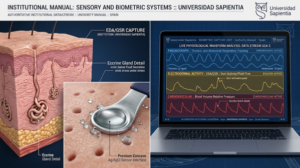
Comprehensive Syllabus Breakdown: The Program Matrix
The manual unfolds progressively across twelve highly technical chapters, structured to transform the reader from an instrument operator into a true forensic psychophysiologist:
Part I: Foundations and the Instrument
- Chapter 1: The Nature of the Test and the Stimulus Pathway: This module structurally dismantles the «lie detector» myth. It introduces the biological zero-point (Homeostasis and Baseline) and maps «The Stimulus Pathway»: the neuroanatomical journey an acoustic stimulus takes through the tympanic membrane, the mechanical-electrical transduction in the Organ of Corti, the thalamic relay, Wernicke’s area, and the visceral scrutiny of the amygdala and hippocampus, which triggers the autonomous emergency response in the hypothalamus of a deceptive subject. It details the respiratory, cardiovascular, and electrodermal efector channels.
- Chapter 2: The Human Factor: This section shifts the archetype from the aggressive police interrogator to the aséptic Clinical Forensic expert. It explores tactical empathy and rapport as biometric stabilization tools, and breaks down cognitive biases, including the lethal «Othello Error» (interpreting the anxious dread of an innocent subject as a sign of guilt). It details the clinical protocols to assess physical, psychological, and toxicological suitability (Suitability Assessment).
- Chapter 3: Equipment and Biosensors: An in-depth medical engineering blueprint of the hardware. It analyzes the Data Acquisition System (DAS), covering transduction via state-solid piezoresistive crystals, medical-grade amplification, active analog filtering, and the Analog-to-Digital Converter (ADC) sampling raw data up to 1,000 Hz at 32-bit resolution. It covers double-pneumograph mechanics (Boyle’s Law), the hydraulics of the blood pressure cuff tracking the dicrotic notch, photoplethysmography (PPG), and unpolarizable Silver/Silver-Chloride (Ag/AgCl) contact engineering for EDA.
Part II: Anatomy of the Examination (The Step-by-Step Protocol)
- Chapter 4: Conditions and Environment: Draconian requirements for the examination suite as a macro-sensor perimetral barrier. It details acoustic isolation and white noise against the startle response; visual sensory deprivation (blocking windows and removing clocks to eliminate temporal pressure); thermal stability at 21-22°C to prevent sweat gland saturation; and 135-degree proxemic geometry to eliminate the Clever Hans effect. It covers the Informed Consent document and the psychological paradox of the signature.
- Chapter 5: The Pre-Test Phase: The tactical core where 80% of the test’s validity is secured. It details behavioural calibration (Norming) and the injection of «White Cognitive Load» (forcing honest memory retrieval) to map the subject’s baseline. It covers the «Issue Pivot,» the engineering of belief, and operant conditioning (Placebo and Nocebo effects).
- Chapter 6: Semantic Engineering and Question Architecture: Algorithms for question design. It prohibits emotionally charged «trigger wHUMINTords» («murder,» «rape») and enforces kinetics and action verbs. It details the «Funnel Effect» to destroy moral rationalizations, and maps the test matrix: Irrelevant (IR), Relevant (RQ), and the differential threat of Comparison Questions (CQ).
- Chapter 7: The In-Test Phase and Rhythm Control: The perito executing a monastic vocal asépsis. It covers the management of the ischemic window (5-minute charts limit) and the mandatory Inter-Question Interval (IQI) of 20-25 seconds to respect homeostasis. It details multi-chart replication and rotational stimulus algorithms.
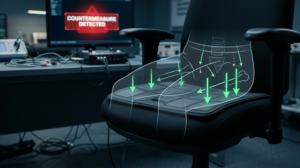
- Chapter 8: The War Against Fraud (Countermeasures and Sabotaje): The definitive manual to detect, expose, and neutralize physical countermeasures (biting the tongue, toe pressure), mental counters (arithmetic calculations, trauma recall), and pharmacological blocks (beta-blockers, topical anhidrotics). It details the use of piezoelectric Seat Pads (seismographic activity sensors) and the final administrative verdict of Purposeful Non-Cooperation (PNC).
- Chapter 9: The Post-Test Phase and Mathematical Scoring: Purifying signals via Artifacting (excluding coughs, swallows, or exogeneous noises). It teaches Phasic Feature Extraction and the Empirical Scoring System (ESS), calculating horizontal totals and Spot Scores. It covers Cut-off Scores to issue the official APA trinity verdict: Deception Indicated (DI), No Deception Indicated (NDI), or Inconclusive (INC), cross-checked by PolyScore and OSS-3 AI models.
Part III: Operational Application and Real-World Arenas
- Chapter 10: Corporate Polygraphy and Human Resources Vetting: Implementing the instrument as a biometric firewall against the Insider Threat. It covers Pre-Employment Screening, the macro deterrence effect, and the legal off-limit zones (religion, politics, union status) under European GDPR and US EPPA parameters. It details the Cleaving Protocol to transition from multi-issue testing to single-issue verification, and the writing of the final Suitability Report.
- Chapter 11: Criminal Investigation and Penal Justice: Surgical protocols for high-pressure cases (homicides, violent assaults, and sex crimes), breaking down the abstract concept of consent into measurable physical coercion. It covers CCTV preservation, HASH cryptographic sealing, and the PCSOT (Post-Conviction Sex Offender Testing) containment approach, demonstrating how regular testing drops sexual recidivism from 40% to under 5%. It details vicarious trauma management and the legal boundaries of the Duty to Warn (Tarasoff doctrine).
- Chapter 12: High Security, Geopolitics, and Civil Conflicts: Polygraphy applied to Critical Infrastructure (nuclear plants, telecom grids), C-Suite vetting during hostile takeovers, and Biometrically Enforced NDAs. It addresses civil inheritance disputes, domestic theft, and the digital labyrinth of micro-infidelity (Sexting, dating apps) vs. abstract emotional desire. It enforces pediatric red lines (prohibiting testing under age 12), exposes media polygraph fraud (the earpiece trick), and provides legal defense guidelines against liability claims through AES-256 data destruction protocols and the strict APA/EPA Deontological Code.
Featured Passages: Direct Excerpts from the Manual
To truly understand the operational weight and narrative authority of this text, we must look directly at its pages. As I establish in the Preface, this book is designed to live permanently open on your desk as a shield of empirical truth:
«Throughout my years in academic, institutional, and operational leadership within the field of forensic psychophysiology, I have consistently witnessed a historical and structural void in our technical literature […] What our discipline lacked was the ultimate operational and tactical link: the titanium bond connecting the cold science of the laboratory with the grit and ruthless reality of the frontlines. Polygraph Testing is born with an uncompromising mandate to settle that debt. This text is not a compendium of abstract theories, nor a philosophical debate on the morality of deception. It is, in its purest, most assertive, and highly technical conception, the engine room of our discipline.»
The manual abandons popular moralizing and approaches deception through the lens of pure survival metrics, as demonstrated in this passage from Chapter 2 regarding the clinical demystification of the «cold-blooded» psychopath:
«The conceptual error lies in misunderstanding what the polygraph measures. It is entirely true that the primary psychopath lacks affective empathy, feels no moral remorse for the damage inflicted on the victim, and suffers no ‘religious guilt’ when lying […] But the polygraph does not measure moral guilt; it measures the Fear of Detection and its immediate consequences. The psychopath is, by clinical definition, a hyper-rational, profoundly egocentric individual obsessed with his own survival, comfort, power, and freedom. When the psychopath sits in the examination chair, immobilized by sensors, his brain evaluates the scenario with a cold, purely confident arithmetic: ‘If this expert and this machine catch me today, I will spend the next thirty years in a maximum-security prison…’. That exact perspective of losing HIS freedom deeply terrifies his amygdala. This exacerbated egocentrism triggers the Sympathetic Nervous System with brutal force […] Consequently, his electrodermal and cardiovascular channels trace the most spectacular, clean, and easily scored deception peaks in the entire profession. The greatest of egoists sweats pure terror for his own skin.»
Official Distribution Channels and Formats
To ensure immediate international access for expert witnesses, corporate security directors, and academic institutions, Polygraph Testing is officially distributed through the following authorized secure channels:
- Premium Digital Edition (High-Resolution Secure PDF)
Available for instant digital download directly through the official Sapientia University forensic book gateway. This technical version is fully optimized for cross-device academic reference and includes all cryptographic validation features.
- Official Purchase Link
- Secure Payment Gateways: Fully integrated with end-to-end encryption via Stripe and PayPal. Digital delivery and automated download links are triggered instantly upon successful payment confirmation.
- Official Academic Price: $71.88
- File Size: 17.45 MB
- Kindle Digital Format (Amazon KDP)
For professionals, researchers, and advanced students who prefer reading and archiving material within the Amazon Kindle ecosystem, the digital edition is available for global acquisition.
- Upcoming Printed Print-on-Demand Edition (Paperback)
For field examiners and university libraries that require a physical copy available on their desks for daily scoring and methodological review during active cases, I am pleased to officially announce that starting August 2026, the work will be available in physical print as a high-durability, softcover paperback book. Pre-order forms for the print edition will be enabled on the same university portal during the summer semester.
Do not allow your professional practice or your organization’s risk management protocols to remain conditioned by obsolete material from the past century. Master the engineering of language, understand the raw physics of biomedical tracking, and descend with me into the engine room of modern forensic psychophysiology.
José A. Landa
President of the European Polygraph Association (EPA)
Director of the European Polygraph Academy
Copyright © 2026, José A. Landa. All rights reserved. Sapientia University / European Polygraph Academy
Comentarios recientes